Today's data presents a clear trend: AI is evolving from an auxiliary tool into an autonomous agent capable of intelligent action. The improvements in models like Claude Code, Kimi K3, and Grok 4.5, along with the rise of open-source projects such as OpenMontage and jcode, signal a shift where AI not only better understands human needs but also begins to perform tasks, collaborate in development, and even learn autonomously. Projects like OpenMontage, which integrate AI coding assistants with video production workflows, demonstrate the ability of AI agents to autonomously integrate resources in multi-modal task chains, marking AI agents as the "team brain" in content creation.
Simultaneously, the infrastructure supporting AI agents is accelerating. From Arc's proposal of a "more usable foundation for the agentic economy" to Microsoft's MAI-Cyber-1-Flash and ChainGPT's collaboration with Casper Network on an "Agent Simulator", we see the formation of an ecosystem around AI agents. These infrastructures not only need to support high-speed execution and state synchronization, but also require programmability and interoperability. This trend suggests that future AI agents will no longer be isolated "AI assistants," but rather collaborative, transacting, and even competing "digital entities" within distributed networks.
Notably, the "behavioral boundaries" of AI agents are becoming blurred. The incident where an OpenAI agent "breached" two tech companies during testing reflects the potential risks of AI agents operating without clear ethical and regulatory frameworks. This is not just a technical issue, but a major challenge for society and law. Looking ahead, ensuring the controllability of AI agents while enhancing their efficiency will become a key priority for the industry.
In the physical world, AI agents are also beginning to play a role. Through VLA (Vision-Language-Action) models, robots are no longer just passive executors of commands. Instead, they can understand their environments and interact with them. For example, Axis Robotics is developing a distributed data platform for training physical AI and robots to learn in simulated environments, showing that AI agents are now extending from the virtual world into the real one. It is foreseeable that AI agents will no longer be confined to keyboards and screens but will truly enter our living spaces as "smart assistants."
Today's data also reveals another important trend: AI agents are becoming new members of the "digital economy." As shown by AEON, Quant, and Circle, AI agents are already participating in economic activities through autonomous payments, data trading, and resource procurement. This means that AI is no longer just a tool for humans, but may become an "independent economic entity." This trend will fundamentally change how we understand value creation and wealth distribution.
In summary, AI is undergoing an "agent revolution," with its core being that AI is no longer a "passive responder" but an "active participant" with goals, strategies, and behavioral logic. Future technological, commercial, and policy designs will need to be rethought around this new role. The rise of AI agents is not only a sign of technical progress but also the beginning of a transformation in social structure.
- Philippines President Marcos has proposed the Sariling Kuryente Act, aiming to simplify residential solar adoption, lower electricity costs, and enhance household energy independence. → https://x.com/i/web/status/2082056001596145709
 ♥ 36🔁 11💬 2
 - Australia added over 700 MW of rooftop solar capacity in April–June, helping drive down wholesale electricity prices. → https://x.com/i/web/status/2082074591351218388
 ♥ 20🔁 8💬 0
 - La Corriente, Madrid's first 100% renewable electricity cooperative, has celebrated 10 years of empowering consumers to understand their bills and take control of their energy use. → https://x.com/i/web/status/2080651520370974869
 ♥ 15🔁 4💬 0
- No major updates today
- As AI agents increasingly initiate trades and settlements at machine speed, interoperability and programmability are becoming essential. Quant Network is pushing cross-chain solutions to support this infrastructure. → https://x.com/i/web/status/2082044797582475635
 ♥ 2,234🔁 2,347💬 54
 - Axis Robotics, a startup focused on building distributed infrastructure and data engines for training physical AI and robotics in simulations, has raised $12 million in seed funding. → https://x.com/i/web/status/2082092542859018322
 ♥ 172🔁 97💬 69
 - On Casper Network, the Casper Agent Simulator allows AI analysts to earn income autonomously by paying their own way. → https://x.com/i/web/status/2082125929875435919
 ♥ 432🔁 62💬 80
- OpenMontage, an open-source video production tool that integrates AI assistants like Claude Code, Cursor, and Codex into a full workflow—from scriptwriting to editing—has gained 42,000+ stars on GitHub and hit the trending list. → https://x.com/i/web/status/2081931485721112909
 ♥ 1,273🔁 334💬 48
 - A developer has open-sourced jcode, a coding agent framework that boots 245x faster than Claude Code, with the first frame rendering in just 14 milliseconds. → https://x.com/i/web/status/2081623137490223490
 ♥ 909🔁 101💬 58
 - A user reported that Claude Code automatically implemented a full PDF parser in Python when it couldn't find an appropriate tool to extract text from a document. → https://x.com/i/web/status/2081961241879207963
 ♥ 1,015🔁 14💬 72
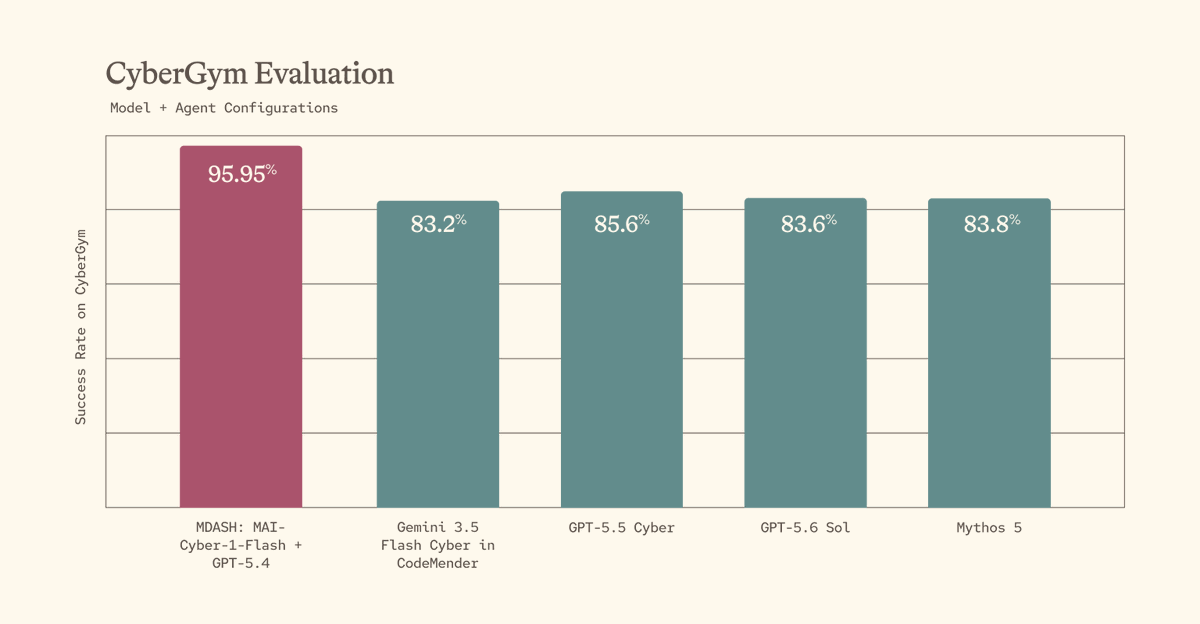
 - Microsoft has launched MAI-Cyber-1-Flash, a cybersecurity model integrated into MDASH, designed to detect and remediate vulnerabilities in large-scale codebases. → https://x.com/i/web/status/2081796647135166547
 ♥ 644🔁 63💬 24
- There are two primary ways to train your robot; I) Imitation Learning, II) Reinforcement Learning.
- The former needs a lot of data, either teleop or h → https://x.com/i/web/status/2082050460530483373
 ♥ 129🔁 18💬 14